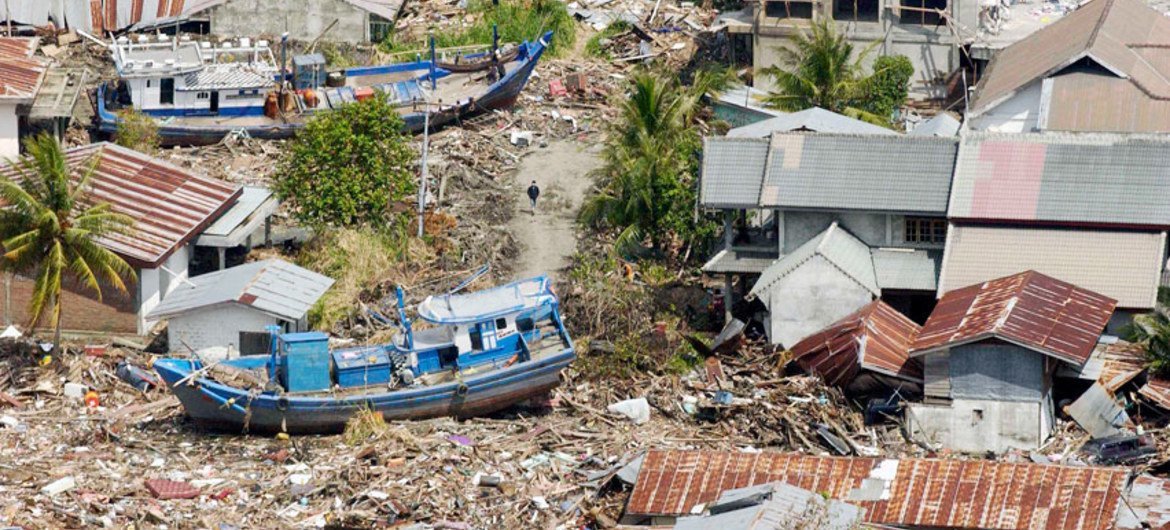
On September 30, 2009, a powerful 7.6-magnitude earthquake struck off the coast of Sumatra, Indonesia, causing widespread destruction and loss of life. The earthquake’s epicenter, located near the city of Padang in West Sumatra, triggered the collapse of buildings and infrastructure across the region. Official reports confirmed 1,115 fatalities, with 1,214 severely injured and thousands more suffering minor injuries.
The devastation extended to over 135,000 homes that were severely damaged, leaving 250,000 families, or 1.25 million people, homeless or displaced. Hard-hit areas like Padang, Padang Pariaman, and Agam faced the brunt of the destruction, struggling with collapsed buildings, disrupted communication lines, and overwhelmed local resources. Immediate humanitarian assistance was critical to support survivors and coordinate relief efforts in this disaster-stricken region.
IHP’s Support to UNDAC and OCHA: ICT and Base Camp Deployment
In the aftermath of the Sumatra earthquake, the International Humanitarian Partnership (IHP) responded swiftly to support UNDAC (United Nations Disaster Assessment and Coordination) and OCHA (United Nations Office for the Coordination of Humanitarian Affairs) in their relief efforts.
ICT Support
IHP deployed specialized Information and Communication Technology (ICT) modules to reestablish essential communication networks in the affected region. The modules were equipped with satellite phones, laptops, GPS devices, and internet access capabilities, enabling UNDAC teams to conduct real-time assessments, share information, and coordinate aid delivery. This ICT infrastructure proved vital in overcoming the region’s severely damaged communication systems, allowing humanitarian teams to operate efficiently across multiple locations.
Base Camp Establishment
In addition to ICT support, IHP facilitated the setup of a base camp near the epicenter to house and support humanitarian workers from UNDAC, OCHA, and other agencies. The camp provided accommodation, office spaces, and kitchen facilities, ensuring a secure and functional environment for responders to focus on their critical missions.
The IHP’s swift action in deploying both ICT solutions and base camp infrastructure played a key role in enabling coordinated and effective relief efforts in Sumatra. This mission highlighted the importance of partnerships and preparedness in responding to large-scale natural disasters.
Cover Photo Credit: UN Photo/E. Schneider